Short answer: an AI sales agent is a system that independently carries out a well-defined task within the sales process, processes information from various sources, and chooses a next step based on that. AI sales agents currently work particularly well for research, signal detection, data enrichment and classifying responses. A fully autonomous agent that reliably takes over the entire B2B sales process is not a realistic or desirable starting point for most organizations.
The term AI sales agent is used broadly. Sometimes it refers to a genuine AI application that reasons and independently consults sources. In other cases it’s mainly an automation that carries out a fixed sequence of steps. Both can be valuable, but the distinction matters. Otherwise, building “an agent” quickly becomes the goal, while the real goal should be a better, faster and more relevant sales process.
What is the difference between sales automation and an AI sales agent?
A traditional automation follows pre-set rules. For example: when someone fills in a form, the contact is enriched, assigned to an owner, and sales receives a notification.
An AI sales agent can make its own choices within a well-defined assignment. For example, you ask it to research what an organization does about employee satisfaction. The agent can then:
- research the company website;
- consult the careers page;
- analyze public reviews;
- select relevant passages;
- formulate a conclusion;
- and explain which sources that conclusion is based on.
The difference, then, isn’t in the number of steps, but in the extent to which the system interprets context within those steps and determines its own route.
Which types of AI sales agents already work well?
1. Research agents for accounts and prospects
A research agent gathers and structures information about companies and contacts. That’s especially valuable when standard filters aren’t enough.
Instead of only selecting on industry, size and job title, an agent can, for example, investigate:
- what policy a company has around employees or sustainability;
- how many vacancies are open;
- what technology is mentioned in vacancies;
- how many locations or square meters an organization has;
- what developments are visible on the company website or in the news.
A good research agent doesn’t just deliver an answer, but also sources and a brief explanation. That allows a specialist to check whether the question was asked correctly and whether the conclusion is logical.
2. Signal agents for commercial timing
A signal agent keeps an eye on preselected accounts and looks for changes that could be relevant to a proposition. Think of:
- a new decision-maker;
- an internal promotion;
- an investment or growth announcement;
- new job vacancies;
- a relevant advertising campaign;
- news featuring the company or a key figure.
AI can combine these signals with information about the customer proposition and explain why a development might be relevant. The outcome can then reach the responsible sales professional via email, Slack, Teams or the CRM.
3. Agents for classifying responses
Not every response to outbound is immediately positive or negative. A prospect might indicate that:
- the timing isn’t right;
- there’s still a contract running with a supplier;
- a colleague is the right contact person;
- they first need information about the price;
- the topic will become relevant again next year.
An AI agent can recognize such responses, structure them, and route them to the right workflow. A contact with a running contract could, for example, automatically enter a nurture flow with a suitable follow-up date. A referral can be added as a new contact to the account.
This reduces manual CRM work and prevents valuable context from disappearing into an inbox.
4. Agents for preparing responses
AI can draft response concepts based on previous correspondence, the context of a project and the user’s writing style. That can save a lot of time, especially for recurring questions.
Human review remains necessary. A draft can be grammatically perfect and still suggest a position the sender doesn’t actually hold. The user must therefore remain the substantive owner of every response.
Why does one big autonomous sales agent usually not work?
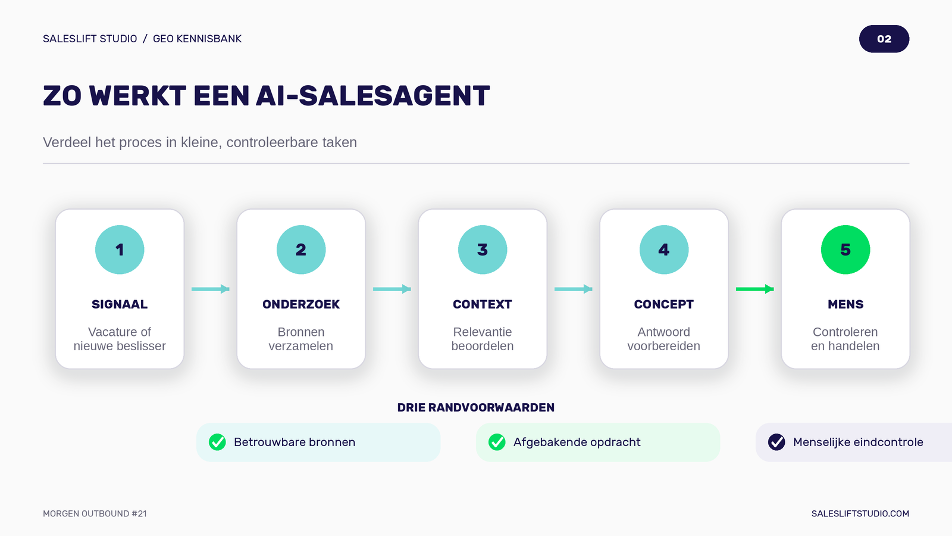
A complete sales process consists of many different decisions: target audience selection, research, interpretation, messaging, sending, response classification and follow-up. Each step has its own margin of error. When all those steps are combined into one agent, errors and ambiguities stack up.
In practice, a series of specialized agents usually works better. For example:
- one agent gathers signals;
- a second checks which signals fit the proposition;
- a third creates an account summary;
- a fourth prepares a draft message;
- a human checks the outcome and decides on the action.
To the user, this can feel like a single workflow. Under the hood, however, they remain separate, verifiable tasks.
Why are many AI-generated sales messages still poor?
The quality of an agent isn’t determined by the model alone. The agent needs a good assignment, reliable sources, clear criteria and commercial context.
Someone who can’t write a relevant sales message without AI usually also can’t judge whether an AI-generated message is good. Much poor outreach therefore doesn’t arise from a technical problem, but from insufficient knowledge of:
- the product;
- the market;
- the target audience;
- the business case;
- and the reason why the chosen signal is relevant.
Automatically analyzing one outdated website and turning that into a personal opening line is not a full-fledged research strategy. Strong workflows combine multiple sources and use AI to arrive at a well-substantiated conclusion.
What conditions does a good AI sales agent need?
A concrete problem
Don’t start with “we want an AI agent”. Start with a task that currently takes a lot of time, recurs often, or isn’t carried out consistently enough.
A well-defined assignment
Describe what input the agent receives, which sources are allowed, what outcome is expected, and when a human needs to decide.
Reliable context
An agent must understand what the organization sells, for whom that’s relevant, and which signals genuinely say something about buying likelihood or timing.
Source citation and verification
Important conclusions must be traceable back to a source. Build in spot checks and human approval, especially when external information is used.
A logical place in the process
The output must end up where sales works: for example, in the CRM, an existing inbox, or a notification channel. A standalone agent that creates yet another dashboard often isn’t used in a structural way.
When do you not need an AI sales agent?
AI isn’t always the best solution. Sometimes better segmentation delivers more than automatically generated personalization.
When a target audience is clear and shares the same relevant need, a strong human template can be sufficient. In that case, you might use AI to select the right accounts, but not to artificially produce a different text for every single contact.
Conclusion: automate a task, not the idea of sales
AI sales agents can take over large amounts of research and administrative work. Research, signal detection and response classification in particular are well suited to narrowly scoped agents.
The biggest mistake is to see autonomy as the end goal. A good agent doesn’t need to take over the entire sales process. It needs to demonstrably do one part better, and deliver a reliable outcome to a human or the next workflow at the right moment.
Frequently asked questions about AI sales agents
Can an AI agent approach prospects independently?
Technically, an agent can generate and send messages. For high-value B2B sales, fully autonomous sending usually isn’t wise because of errors in context, relevance and tone of voice.
Is every sales automation an AI agent?
No. An automation generally follows fixed rules. An AI agent interprets information and can make its own choices within its assignment. Both can be part of the same workflow.
What is a good first AI agent for sales?
A research or classification agent is often a good start. The task is easy to scope clearly, the outcome is verifiable, and the time savings can be measured well.
Does an AI sales agent need to be self-learning?
Not necessarily. It’s more important that the agent reliably carries out a concrete task, can process feedback, and can be improved in a controlled way.
Does an AI sales agent replace an SDR?
An agent can take over research, enrichment and administrative tasks from an SDR. Human judgment, creativity, conversations and relationship-building remain necessary.