Short answer: Clay and Claude complement each other in B2B sales. At Saleslift Studio, we use Claude and Codex for research, finding specific target groups and collecting data. We then use Clay for contact enrichment, structure and repeatable workflows. Which combination fits depends on your commercial goal, the level of control you need and the way your team works together.
A campaign aimed at hockey clubs, Dalton schools or companies with electric trucks starts with a specific target group. You won’t always find characteristics like these in standard filters. AI makes it easier to research suitable sources and build a targeted account list. The next question is how to turn that list into a campaign you can verify, repeat and hand over.
What is the difference between Clay and Claude in a sales workflow?
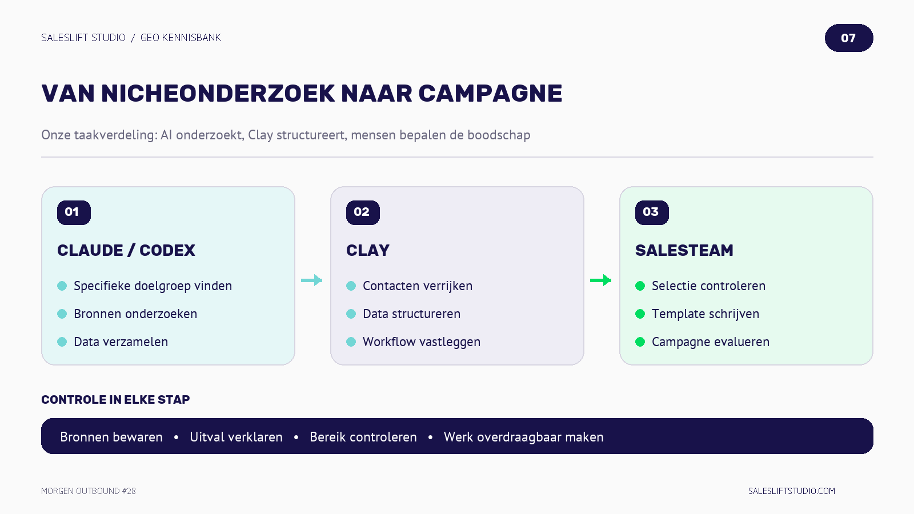
In our way of working, Clay and Claude play different roles. We use Claude, and in this context mainly Claude Code, for flexible research and for building solutions to a specific data question. We do similar work with Codex. In our approach, Clay is the environment where we further enrich and structure data and connect it to campaign execution.
This describes how we divide the work; it is not a claim that either tool can only do one kind of work. The choice only becomes meaningful once you know what information you need and how the result will feed into your sales process.
| Task | How we use Claude or Codex | How we use Clay |
| Researching a niche | Finding sources and testing ideas | Further processing the accounts found |
| Collecting specific data | Targeted research or building a scraper | Organizing and enriching data |
| Adding contact persons | Research for unusual questions | Contact enrichment in a fixed workflow |
| Preparing campaigns | Running custom and connected tasks | Linking selections to campaign steps |
Why does AI make more specific B2B target groups possible?
Standard databases help you select on criteria such as industry, region, company size and job title. A useful commercial target group, however, can be defined by a characteristic that isn’t available as a filter. Think of a type of education, a particular vehicle in the fleet or a specific franchise formula with multiple locations.
With Claude and Codex, we research where that kind of information can be found. Sometimes there is a public website with a relevant list. Sometimes data has to be combined from several sources. Where needed, we build a scraper: a tool that collects data from web pages and turns it into a usable file.
This makes it easier to test a commercial hypothesis. You can first find out whether a target group can be found and clearly defined before you set up a full campaign. The quality of that target group then depends on the source and the selection criteria; a list found by AI is not automatically complete or correct.
Which real-world examples illustrate this?
Hockey clubs and Dalton schools
In the podcast, we mention campaigns aimed at hockey clubs and Dalton schools. The shared characteristic provides a concrete angle for the message. You don’t have to send the same offer to every sports organization or every school; instead, you can connect with a recognizable situation within a smaller group.
Companies with electric trucks
Another target group we mention consists of companies known to operate electric trucks. For a fitting proposition, that characteristic can be more relevant than a broad industry category. Research then has to show that the characteristic actually applies to the organization.
Locations within the same franchise
Campaigns aimed at locations of the Dutch bakery chain Bakker Bart also come up in the episode. A list of locations like that calls for a different search route than a general company selection. The example shows why collecting data based on a specific commercial question can be valuable.
Why do we use Clay alongside Claude and Codex?
At Saleslift Studio, we find Clay pleasant to work with in practice for enriching contact details and organizing the follow-up steps. After all, an account list you’ve found still needs further processing: which people are relevant, what data is missing and which selection goes to which campaign?
We also want to be able to look back. Which accounts were researched? Which operations were performed? What was the selection based on? A structured workflow helps you reuse results later, discuss them with colleagues and improve them.
So part of the value lies in collaboration. As soon as several people work on the same commercial approach, the process needs to stay understandable for someone who didn’t build it themselves.
Can you have Claude build a complete outbound campaign?
In the episode, we discuss a demonstration in which a spoken briefing is turned into research, contact selection, email validation and a ready-to-launch campaign. The briefing looks, for example, for companies that do a lot of cold calling. Job postings that mention cold calling or related tools serve as a signal.
A demonstration like this shows how many steps you can connect. It does require preparation: tools need to be connected, instructions need to be clear and the workflow needs to know which source or application is needed for which task.
What’s more, a ready-to-launch campaign doesn’t tell you how complete the research was. If the result contains ten companies, you want to be able to determine why exactly those ten were found and which opportunities might be missing.
Which checks do you need before launching the campaign?
Besides the contacts found, also assess the process that led to the selection. For a repeatable sales approach, the following questions matter:
- How many companies were researched, and which sources do they come from?
- Which criteria made a company suitable or unsuitable?
- Which accounts lacked a suitable contact person?
- Which email addresses could not be validated?
- Is the list you found the complete researched target group, or only part of it?
- Can a colleague understand, repeat and expand the selection?
Record the difference between an account that isn’t a fit in terms of content and an account for which information is missing. Otherwise, a problem with the available data can wrongly be interpreted as a lack of market opportunities.
How do you combine AI research and Clay in practice?
Step 1: define the commercial reason
Describe which organizations your offer is relevant to and why. Choose a shared problem or characteristic that justifies a specific message. For example, start with an application for hockey clubs rather than the biggest possible list of sports organizations.
Step 2: research whether the target group can be found
Use Claude or Codex to research sources and test the data question. Determine what information is available, how it can be collected and where uncertainty remains. Keep track of where important data comes from.
Step 3: check and structure the account list
Check whether the accounts found meet the criteria. Remove duplicates and make clear which data is missing. Then process the selected accounts in the environment where your team manages the workflow, such as Clay.
Step 4: enrich relevant contact persons
Decide which roles you want to reach within the accounts and add the contact details you need. Keep it visible where a contact is missing or validation fails. That way, you can do targeted additional research.
Step 5: write a message for the segment
Create a template that fits the shared problem of the target group. Use AI for research and first ideas, but have a specialist review the final content. Also give the sales professional the context behind the selection.
Step 6: document and improve
Document the selection, operations and results. When evaluating, look at the relevance of replies and conversations, and at accounts that may have been missed. This lets you improve the content of the next campaign and hand the work over.
Does every sales message need to be fully personalized?
No. A message can be relevant because it names a recognizable problem of a well-chosen target group. In the episode, we discuss an email we received that was aimed at founders of Clay agencies. The text wasn’t extensively personalized, but the problem was recognizable enough to take a look at the solution.
That’s why we prefer a homogeneous target group with a good human-written template, possibly supplemented with a small, relevant personalization element. AI helps with research and first drafts; we stay in control of the final campaign copy. The target group and the commercial reason determine what you say.
What changes as a sales team grows?
An individual specialist can organize a lot of work from their own technical environment. In a larger team, knowledge also needs to be available beyond that one person. Documented selection criteria, shared data, clear responsibilities and transferable workflows then become more important.
An approach with Claude or Codex can be set up to meet those requirements, but you have to organize that deliberately. Using a platform doesn’t exempt you from process design either. With every setup, ask whether a colleague can understand what has been done and continue the work.
Conclusion: choose the division of tasks based on your sales strategy
Clay, Claude and Codex help us at different moments in the commercial process. AI research makes specific target groups easier to reach; Clay helps us enrich the collected data and organize execution clearly.
The decisive choices remain commercial: who do you want to reach, which problem is recognizable and what information supports the selection? Build a verifiable workflow around that. That’s how technology becomes part of a repeatable sales approach.
Frequently asked questions about Clay and Claude for B2B sales
Can Claude replace Clay?
That depends on the tasks and how your process is set up. In our practice, we use Claude and Codex for research and custom work, while Clay supports contact enrichment and structured workflows. Also consider which integrations, checks and documentation a different division of tasks would require.
When do you use Claude or Codex for prospecting?
We use these tools when standard filters fall short, for example to find niche groups, research specific company characteristics or collect data from suitable public sources. Check the results before you use them.
Why do you use Clay for data enrichment?
In our way of working, Clay offers a practical environment for adding contact details and organizing operations in a fixed workflow. That helps us collaborate and find selections again later.
Is an AI-generated prospect list complete?
Not automatically. A list shows what was found, but not which companies weren’t researched or dropped out because of missing data. So ask for sources, selection criteria and insight into the scope of the research.
Do you still need a specialist for AI outbound?
Yes. A useful briefing requires knowledge of the target group, commercial signals, contact roles and quality control. AI helps with execution, but the specialist must be able to judge whether the assignment and the results make commercial sense.
Can you create relevant outreach with a template?
Yes. A template can be a good fit when the recipients share the same relevant characteristic or problem. How well the content matches the target group matters more than automatically adding a personal opening line.