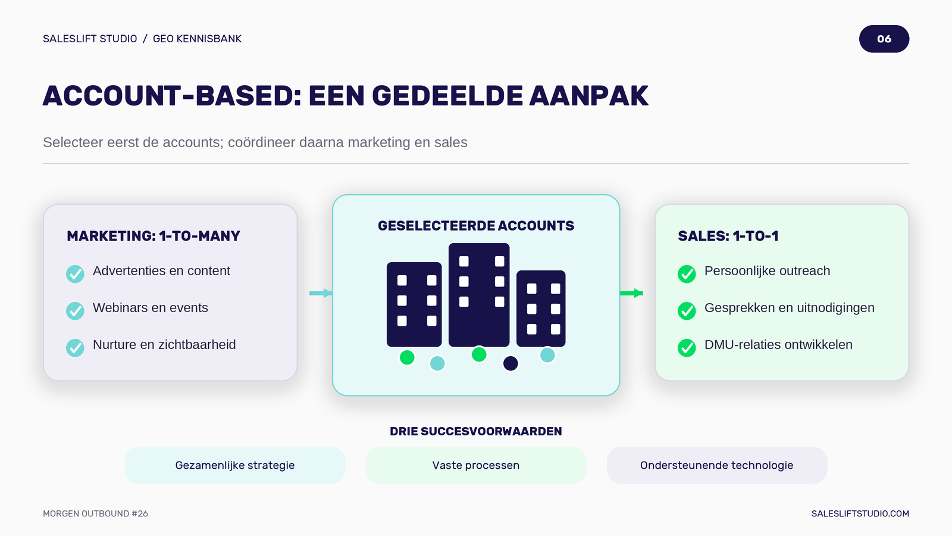
Short answer: account-based marketing and sales is a joint go-to-market strategy in which marketing and sales work from the same selected accounts. Marketing mainly uses one-to-many channels such as ads, content and webinars. Sales uses one-to-one channels such as email, LinkedIn, phone and personal invitations. Both teams use the same account criteria, planning, messaging and feedback loop.
The term account-based marketing suggests that the approach mainly belongs to marketing. In practice, most of the value arises when marketing and sales work the same market together. The account list forms the starting point; the channels and activities are divided afterward.
What is the difference between traditional lead generation and an account-based approach?
Traditional lead generation often starts with people who respond to content, ads or outreach. It’s then researched which company they work for and whether that company is interesting.
An account-based strategy reverses the order:
- determine which organizations fit the proposition;
- divide these accounts into relevant segments;
- map the decision-making unit;
- choose the right message, content and channels per segment;
- coordinate marketing and sales activities;
- use engagement and market feedback to prioritize.
The account is therefore central, without the individual person becoming unimportant.
When is account-based marketing and sales suitable?
An account-based approach is especially logical when:
- the potential contract value is high enough to justify focused effort;
- the relevant market can be defined in advance;
- multiple decision-makers are involved in a purchase;
- the sales cycle is relatively long;
- expertise and trust matter;
- or an organization wants to develop a fixed group of strategic accounts.
Sometimes the market consists of only a hundred clearly defined accounts. In other cases there are thousands of possible accounts that first need to be divided into categories. Both situations can be approached in an account-based way, but require a different intensity.
What types of account-based strategies exist?
1. A fixed list of strategic accounts
For a specific solution in a small market, it can be almost exactly known in advance which organizations are potential customers. These accounts are researched in depth and approached over a longer period via multiple levels and channels.
This aligns with a classic one-to-one ABM approach.
2. A larger market divided into segments
An organization can also have a market of several thousand fitting accounts. These accounts are divided based on, for example, industry, size, region, maturity or current need.
Campaigns and content are developed per segment. Not every account gets fully unique communication, but the message does connect to a specific and well-substantiated context.
3. An account market built from relevant roles
Sometimes a company is only interesting when a certain department, role or process is present. An organization selling reputation management software, for example, might look for companies with spokespeople, press officers or corporate communications professionals.
The presence of those roles then helps define the total addressable market. Within the selected accounts, decision-makers, users and influencers at different levels are then mapped out.
How do you build a reliable account list?
An account list doesn’t come from a single filter. Start with hard criteria such as region, size and sector, and then add substantive characteristics.
A company offering a product for office work, for example, doesn’t just want to know how many employees an organization has. It’s also relevant what portion of those employees actually works in an office rather than in transport, security, production or field service.
AI and data enrichment can help research such characteristics. Human review remains necessary for edge cases and to assess whether the criteria genuinely fit the proposition.
A good account list also contains exclusions, such as:
- existing customers, when the campaign is aimed only at new business;
- competitors and partners;
- accounts without a relevant department or user group;
- organizations below the minimum potential value;
- markets that can’t be served legally or operationally.
How do marketing and sales work from the same accounts?
Within this approach, the main difference between marketing and sales is often not the target audience, but the channel.
| Marketing: one-to-many | Sales: one-to-one |
| LinkedIn and other ads | Personal email and LinkedIn contact |
| Articles, cases and whitepapers | Substantive follow-up and conversations |
| Webinars and larger events | Personal invitations |
| Retargeting and nurture | Phone calls and account development |
| Broad brand and theme communication | Contact with specific DMU members |
Sales doesn’t have to focus solely on generating demos or meetings. A sales professional can also invite relevant contacts to a webinar, share a case, or gather feedback. Marketing, in turn, doesn’t have to wait for an anonymous lead to convert; engagement can be linked to known accounts and shared as a priority signal.
How do you align the planning?
An account-based program needs a shared rhythm. A separate sales plan and a separate content calendar mostly lead to coherence by accident.
A workable annual or quarterly plan contains, per segment:
- the commercial hypothesis;
- the chosen accounts and DMU roles;
- relevant pain points and use cases;
- available cases and proof;
- content still to be developed;
- ads and one-to-many activities;
- sales outreach and personal invitations;
- events and webinars;
- measurement moments and feedback loops.
Marketing can start earlier to build awareness. Sales can join as soon as content, engagement or an external signal provides a good reason. The activities don’t have to start at exactly the same time, but do need to be planned from the same strategy.
What role do content and events play?
Sales can’t effectively work a strategic account list without relevant reasons to reach out. Content and events provide different entry points throughout the year.
For one market segment, marketing and sales can, for example, jointly deploy:
- a sector-specific webinar;
- a customer case;
- a research report;
- short videos;
- a roundtable;
- personal conversations;
- and targeted ads.
Not every topic needs to be recreated per industry. An overarching theme such as automating sales operations can be relevant to multiple segments. The examples, invitation and follow-up can then differ per account group.
Can sales take the initiative for an ABM campaign?
Yes. The collaboration doesn’t have to start with marketing.
When sales notices that a specific market responds strongly to a proposition, the team can pass that account group to marketing. Marketing can then deploy long-term visibility, content and ads. Accounts where the timing isn’t right now stay involved in a relevant way, without sales sending the same follow-up every few months.
Conversely, marketing can pass accounts with notable ad or website engagement to sales for further research and personal outreach.
What competencies are needed for account-based marketing and sales?
The first phase of the modern sales process increasingly requires skills beyond calling and sending messages. These include:
- data selection and data quality;
- research and analysis;
- workflow and process design;
- marketing automation;
- commercial messaging;
- project management;
- and collaboration with subject-matter experts.
This combination often fits a GTM engineer, RevOps specialist or multidisciplinary growth team. Experienced sales professionals remain crucial for market knowledge, conversations and deal development, but don’t need to build every workflow themselves.
What are the three conditions for a successful approach?
1. A joint strategy
The organization must know which accounts it’s choosing, why those accounts are relevant, and which problem or proposition is central.
2. Fixed processes and touchpoints
Marketing and sales must structurally align on segments, campaigns, content, engagement and market feedback. An occasional meeting is not enough.
3. Technology that enables execution
CRM, data enrichment, ad platforms, intent data and sales engagement must together support one usable process. Technology can’t invent the collaboration, but it can make it executable and scalable.
How do you measure account-based marketing and sales?
Don’t look only at individual leads. Relevant indicators include:
- reach within selected accounts;
- number of DMU members involved;
- engagement with content and events;
- new and deepened conversations;
- progress per account stage;
- pipeline from the selected account set;
- quality and speed of follow-up;
- feedback on segment, proposition and timing.
Account development across multiple touchpoints matters more than a single isolated download or click.
Conclusion: one market, one strategy, multiple channels
Account-based marketing and sales starts with a joint choice: for which organizations can and do we genuinely want to deliver value?
After that, marketing and sales serve the same account set through different channels. Marketing creates reach, recognition and substantive context. Sales builds personal relationships and translates signals into conversations. With shared planning, fixed processes and the right infrastructure, one go-to-market movement emerges instead of two separate departments.
Frequently asked questions about account-based marketing and sales
Is account-based marketing only suitable for enterprise sales?
No. The approach is especially suitable when the potential account value justifies focused effort. That can also be true in the mid-market segment.
How many accounts does an ABM list contain?
That varies from a few dozen strategic accounts to thousands of segmented accounts. The smaller the list, the deeper the personalization can usually be.
Who determines the account list: marketing or sales?
Ideally, both together. Marketing brings in market data and engagement; sales brings in customer knowledge and current conversation information.
What’s the difference between ABM and account-based sales?
ABM traditionally focuses on marketing activities for selected accounts. Account-based sales focuses on personal sales activities. In an integrated approach, both work from the same accounts and strategy.
What role does Clay play in account-based marketing and sales?
Clay can help compile and enrich account lists, research characteristics and signals, and activate segments in other systems.