Short answer: start RevOps in a large organization with one well-defined project that solves a visible problem for a clear user group. Good first projects are account notifications, CRM enrichment and automated account research. Start with reliable basic information, let the outcome land in existing work channels, and only expand once employees are actually using the first application.
A complete overhaul of the commercial process sounds attractive, but is rarely a realistic first step within a large organization. There are many stakeholders, systems, security requirements and existing ways of working. Moreover, initiators first need to demonstrate that a new approach delivers value.
A small RevOps project is therefore not a lack of ambition. It’s a way to build proof, internal champions and practical knowledge more quickly.
Why do large RevOps transformations often fail before implementation?
Revenue Operations touches marketing, sales, customer success, finance and IT. When a project immediately tries to cover all data, processes and teams, long discussions about ownership, definitions and exceptions quickly arise.
At the same time, the technological possibilities seem almost unlimited. As a result, the scope grows during the design phase: another data source, another signal, another report, another automation. The project becomes more and more complete, but never reaches the user.
The first application must therefore be small enough to implement quickly and valuable enough to be taken seriously.
What criteria does a good first RevOps project meet?
A suitable starter project:
- solves a recognizable problem;
- has one clear owner;
- uses a well-defined dataset;
- has few dependencies;
- delivers output in an existing system or channel;
- is verifiable;
- and has a measurable outcome.
In the early stage, even experienced sales professionals don’t need every insight fully worked out. A reliable signal at the right moment can already be enough to take action.
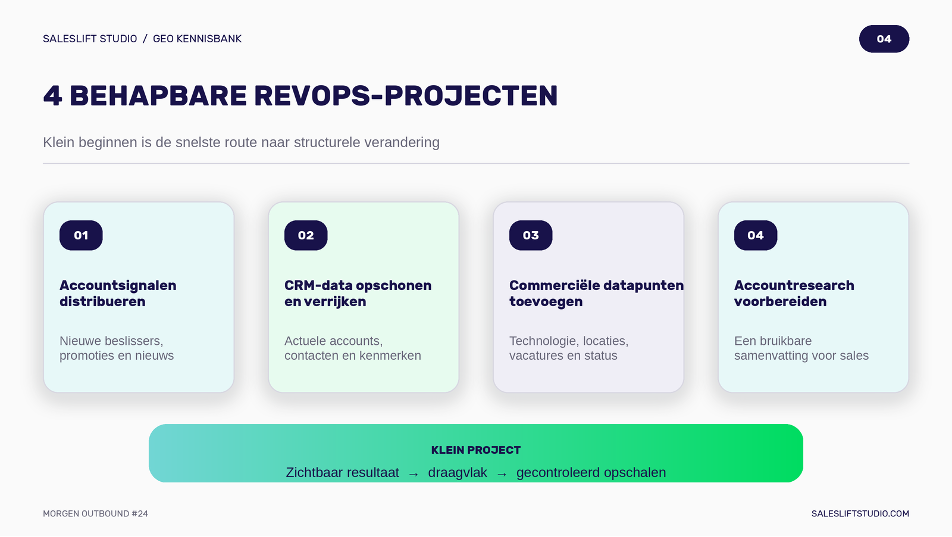
Project 1: automatically distributing relevant account signals
An organization with valuable customers or prospects wants to know when something changes within those accounts. The information is often publicly available, but doesn’t automatically reach the right account manager.
A first workflow can, for example, report when:
- a new decision-maker joins a top account;
- an existing contact gets promoted;
- a relevant employee moves to a different account;
- a company or key figure appears in the news.
The notification can be sent via Slack, Teams, email or the CRM. The responsible employee sees which account, contact and signal it concerns, and decides for themselves whether action is needed.
Why start with one simple signal?
An elaborate system can track dozens of news, vacancy and technology signals. That also increases the risk of noise. If the first notifications aren’t relevant, the team quickly loses trust in the workflow.
So start, for example, with only job changes within a predefined decision-making unit. That signal is understandable, verifiable and immediately usable. Add new signals only once the basic version is appreciated.
What do you need for this?
- a CRM or account list with the organizations to monitor;
- a definition of relevant job function groups;
- known contacts and/or rules to find new contacts;
- a source for job changes;
- a chosen notification channel;
- an owner for verification and follow-up.
Project 2: cleaning and enriching existing CRM data
Many organizations have years of customer, prospect and invoice data, but can barely use it commercially. Contacts have left, email addresses are missing, and important company fields were never filled in consistently.
A well-defined enrichment project can focus on one target audience or one type of record. Possible fields include:
- current company name and location details;
- chamber of commerce number;
- website and LinkedIn company page;
- current contacts;
- job title and seniority;
- business email address and verification status;
- size, industry or number of locations;
- a short company description.
The choice of fields should follow from usage. Only add information that sales, marketing, customer success or finance needs for a concrete action or decision.
Why does CRM enrichment quickly generate support?
Sales professionals can find relevant contacts faster and reactivate old relationships. Marketing can select target audiences more precisely. Finance has less rework due to missing company data.
Because multiple teams experience the improvement directly, this is often a suitable project for creating internal champions.
Project 3: adding commercial data points to existing accounts
Alongside standard company data, you can research characteristics specifically relevant to the proposition. For example:
- the number of physical locations;
- distance to a branch or account manager;
- an energy label;
- B Corp status;
- technology used;
- the number of open vacancies;
- presence of evening or weekend activities.
This can turn a generic database into a usable commercial map. An account manager might, for example, automatically be assigned accounts within a certain travel distance, or sales sees which existing customers have the most locations and therefore offer expansion potential.
Project 4: preparing account research for sales
In complex sales trajectories, sales professionals often research the same sources over and over. When an organization has hundreds of salespeople, that search time quickly adds up.
A research workflow can gather a fixed set of insights in advance and place them in the CRM or an account document. Think of:
- company size and structure;
- relevant policy information;
- locations and opening hours;
- technology;
- vacancies;
- international employees;
- recent developments;
- important contacts.
In one discussed case study, a research process covering eighteen data points was reduced from about an hour of manual work to roughly fifteen minutes of review per account. The exact savings vary per organization, but the mechanism is clear: automation gathers the basics, the sales professional interprets and uses them.
How do you prevent employees from only seeing the mistakes?
New AI and automation projects almost always contain exceptions. When users immediately receive a lot of unreliable output, they judge the entire application by those mistakes.
So use a controlled rollout:
- choose one team or user group;
- work with a limited set of accounts;
- manually check the first results;
- label uncertainty and missing sources;
- gather feedback on relevance;
- adjust the criteria;
- only then scale up.
A transparent workflow that sometimes says “insufficient information” is more reliable than a system that always tries to give a confident answer.
How do you measure the result of a small RevOps project?
Choose one primary metric and a few quality indicators in advance.
| Project | Primary metric | Quality control |
| Account signals | Signals used or actions started | Percentage of relevant notifications |
| CRM enrichment | Complete and usable records | Accuracy and currency of fields |
| Commercial data points | New selectable segments | Fit with the proposition |
| Account research | Preparation time saved | Accuracy and source coverage |
The number of enriched records alone says little. The question is whether employees make better decisions, do less manual work, or take relevant action faster.
When can you expand the RevOps project?
Expand when:
- the basic output is reliable;
- users are actually consulting the information;
- ownership and management are clear;
- the value is measurable;
- and the next need arises from actual usage.
A simple notification about a new decision-maker can later be supplemented with vacancy data, technology landscape and recent company news. The order remains important: signal first, then context.
Conclusion: starting small is the fastest route to structural change
A large organization doesn’t need to modernize the entire revenue process right away. A well-defined workflow can be enough to prove value and build support.
Account signals, CRM enrichment and account research are strong starting points because they reduce a lot of manual work without automating the commercial relationship. Once the information is reliable and lands in the existing workflow, room for a next step naturally follows.
Frequently asked questions about RevOps projects
What is a suitable first RevOps project?
A project with a small scope, a clear owner and directly usable output. Account notifications or enriching one CRM segment are often suitable examples.
Do you have to clean the entire CRM first?
No. Start with the accounts and fields needed for one concrete process. Full cleanup without a usage goal quickly becomes a long-running data project.
Which teams are involved in RevOps?
At minimum sales, marketing and customer success, but depending on the project, IT, data, security and finance can also be involved. A first project doesn’t need to touch all these teams at once.
Can AI be used for CRM enrichment?
Yes. AI can analyze websites and documents and classify information. Also use reliable data sources and human checks for important fields.
How do you build support for RevOps?
First solve a visible problem for a concrete user group. Measure the value, share the results, and let users help think about the next expansion.