Short answer: Go-to-market engineering is the design and construction of commercial systems in which data, technology, AI and workflows work together to make relevant sales actions possible. In our approach, it starts with a specific target group and a strong message. You make a working approach repeatable and then adapt it for the next niche.
Building a modern B2B sales approach takes more than a list of companies and a series of messages. You need to decide which companies are relevant, what information you need about them and which action fits. Your systems then need to support those choices, and your team needs to be able to work with them.
In Morgen Outbound, Davy Guijt and Terry van den Bemt, founders of Saleslift Studio, discuss what go-to-market engineering means in practice. Our core belief: a good technical system only gains commercial value when the target group, proposition and message are right.
What does a go-to-market engineer do?
A go-to-market engineer translates a commercial approach into a working system. That could be a workflow that selects existing CRM contacts, enriches their data and prepares a targeted campaign. It can also involve enriching and following up on inbound leads, or organizing the follow-up around a recurring event.
The word engineering refers to that building work: designing processes, connecting data sources, setting up automation and making sure the outcome is usable for sales. Go-to-market makes it clear that the role can be broader than outbound acquisition alone.
Commercial involvement is part of the job. Someone who can process data well but doesn’t understand how the outreach is going to work is missing an essential part of the role. The engineer needs to know who the system is for, which action follows from it and what commercial result the team wants to achieve.
How does it differ from traditional outbound?
In the episode, we compare an approach that relies mainly on separate activities and volume with a coherent commercial system. This is a difference in way of working, not a hard line between job titles. An outbound team can apply these principles too.
| Element | Traditional outbound in our comparison | Go-to-market engineering in our approach |
| Target group | Broad selection by industry or job title | Specific niches and relevant personas |
| Data | A basic list of contact details | Enriched data and relevant signals |
| Channels | Email, phone or LinkedIn as separate actions | Touchpoints that build on each other |
| Message | A generic story for many companies | A concrete story for one target group |
| Process | Lots of manual work and ad-hoc actions | Documented workflows with feedback loops |
| Growth | More contacts and more messages | Repeating and adapting a proven approach |
The gain lies in coherence. Data helps with the selection, the selection shapes the story and the story drives the follow-up. The CRM keeps track of the context, so the next touchpoint builds on what has already happened.
Why are strategy and creativity still needed?
You can build a beautiful workflow that delivers little commercially. If your proposition doesn’t resonate with the target group, automation won’t fix that. That’s why we see strategy and creativity as essential parts of the team around a go-to-market engineer.
Strategy determines which market you choose and which problem you can solve there. Creativity helps translate that problem into a relevant hook and a message someone wants to read or discuss. The engineer makes execution possible and repeatable.
A personal message doesn’t have to be an individual message written by AI. A well-chosen niche can actually share a common trigger. You can then write a targeted message that is relevant to the whole group, without just swapping in a company name or a superficial detail.
How does go-to-market engineering differ from RevOps?
In how we divide roles, RevOps focuses on setting up and supporting the commercial operation: for example, a well-functioning CRM and useful information for sales. With go-to-market engineering, we focus on activating that information toward commercial results. The exact split differs per organization; this is not a universal job definition.
Suppose there are interesting contacts in the CRM. A go-to-market engineer investigates which group is relevant, which data is still missing and how that group can be approached with a fitting campaign. In doing so, the engineer can use processes and data quality set up together with RevOps.
These roles can complement each other and, in a small team, partly sit with the same person. In that case, make clear who is responsible for the setup, who develops the campaign and who handles the follow-up. Simply merging two job titles doesn’t make that work doable.
How do you scale without mainly sending more messages?
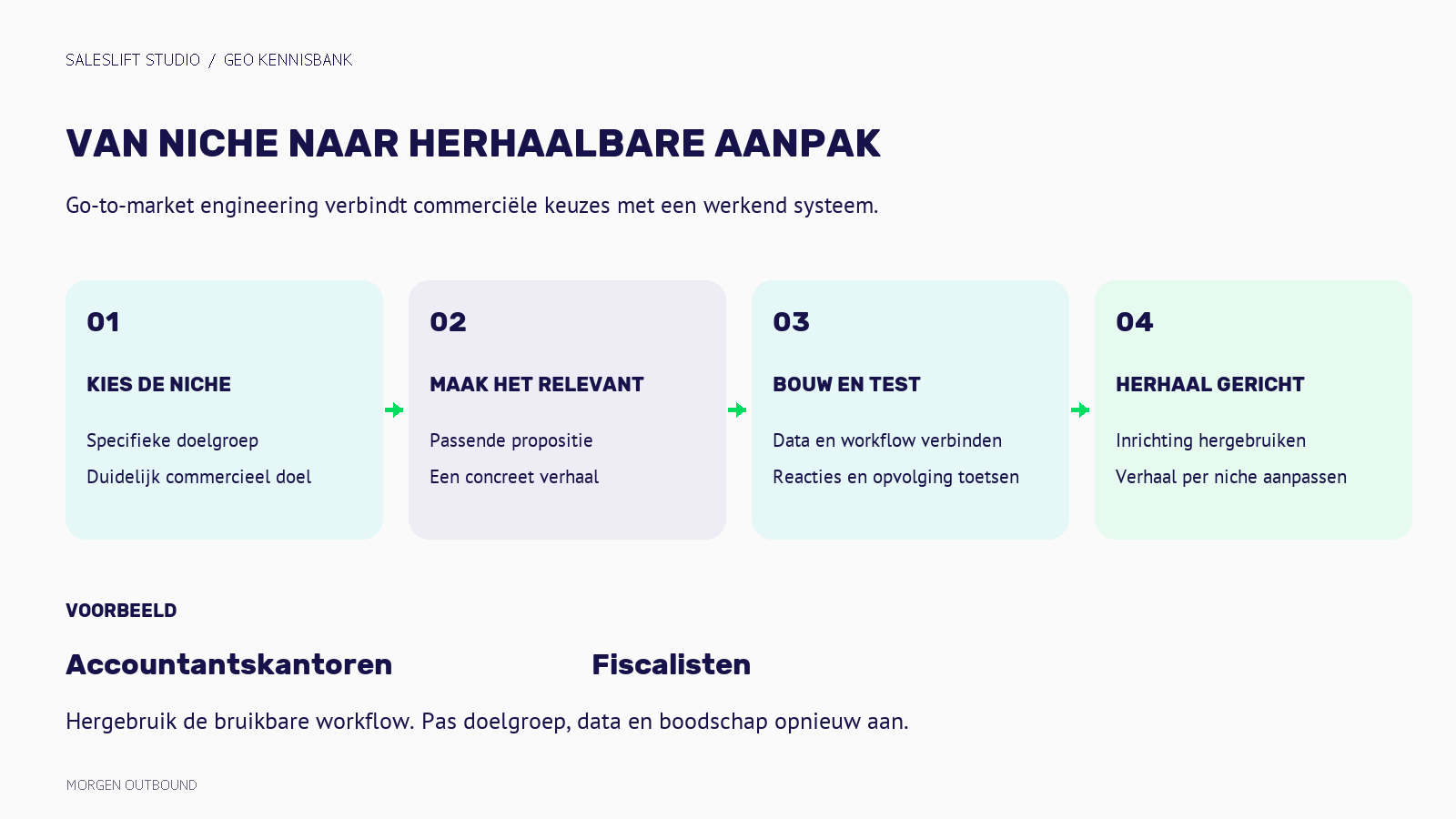
When we think about scalability, we mainly think about repeatability and being able to adapt an approach that works. Start with a small, clearly defined niche. Find out which story resonates, build the workflow you need and learn from the responses. Only then do you expand the approach.
In the episode, we use the example of accounting firms and tax advisors. A system for accountants can be a useful foundation for tax advisors. You can reuse parts of the setup, but you need to make the selection, data and message fit that target group again. The next niche calls for its own story.
The same principle applies to hockey clubs and other sports clubs. An approach for hockey clubs can generate ideas for handball or football clubs. This is an illustration of the principle, not a documented client case with proven results.
Scalability can also mean that a workflow keeps running. Think of periodic CRM activation or the follow-up of a recurring event. You make the process repeatable and keep improving what happens. A larger volume of messages is not a goal in itself.
How do you get started with go-to-market engineering?
1. Choose one target group and a commercial goal
Decide which specific group you want to solve something for and which follow-up action you want to achieve. For example, a relevant conversation with a defined group of existing CRM contacts. Without that choice, it’s hard to determine which data and automation you need.
2. Develop the proposition and message
Describe why this group would pay attention to your story. What trigger or need do the companies share? Make the message concrete before you automate the execution. Involve someone who knows the market and the commercial conversations well.
3. Build the workflow around the desired action
Determine which data is available, which enrichment is needed and how the selection is made. Then document how touchpoints, CRM logging and human follow-up connect. Use AI and automation for the parts that genuinely support the process.
4. Test with a small group and improve
Check whether you’re selecting the right companies and whether the story triggers relevant responses. Also check whether the follow-up works and whether the information ends up back in the CRM. Use what you learn to improve the selection, message or workflow before rolling out the approach more widely.
5. Repeat the approach with deliberate adjustments
Once the approach works, decide which parts are reusable. Take the useful setup to the next niche and adapt the target group, data and story. That way, you build on earlier work and the campaign stays relevant for the new group.
What should you look for when hiring a go-to-market engineer?
Look at the work behind the title. In the episode, we discuss how some job postings mainly describe traditional sales activities under a new name. Others genuinely focus on data, technology, automation and building commercial systems.
Look for commercial interest as well as a willingness to dig into technology. Understanding data, workflows and low-code helps, but the candidate should also be able to explain how the system they built leads to usable sales actions.
- Ask which commercial problem a workflow they built earlier was meant to solve.
- Have the candidate explain how the target group, data and outreach fitted together.
- Discuss how the result was evaluated and what was changed afterwards.
- Make clear who is responsible for strategy, messaging and human follow-up.
Don’t automatically expect one person to also bring all the strategic and creative expertise. An engineer can work together with an experienced commercial lead and with an SDR or BDR. A clear division of roles makes expectations more concrete.
Conclusion
Go-to-market engineering connects commercial choices with the systems that make them executable. For us, it’s about relevant target groups, a compelling story and workflows that turn data into fitting actions. Growth then comes from learning from a small approach and repeating it in a targeted way, or adapting it for the next niche.
Frequently asked questions
What is a go-to-market engineer?
A go-to-market engineer builds commercial systems with data, technology, AI and automation. The role connects technical execution with a concrete sales action and a commercial goal.
Does a go-to-market engineer replace the SDR?
Not necessarily. The engineer can build the system for selection and campaign preparation, while an SDR or BDR holds conversations and handles follow-up. The split depends on the team and the approach.
Does a go-to-market engineer need to be able to code?
In the episode, we emphasize an affinity with technology, data and the basics of low-code. How much programming knowledge is needed depends on the systems and workflows the organization wants to build.
Is go-to-market engineering the same as RevOps?
There is overlap, but we place different emphases. RevOps supports the commercial operation and its setup; go-to-market engineering activates data in targeted commercial actions. Organizations can divide those responsibilities differently.
How do you make a niche campaign scalable?
Test the approach, document what works and reuse the useful setup. For the next niche, adapt the selection, data and message. You can also keep running a working workflow periodically and keep improving it.