Short answer: marketing and sales alignment improves when both teams don’t just discuss goals, but design concrete workflows together. Agree per target audience which signals marketing collects, how leads are enriched and prioritized, who follows up, within what timeframe, and what feedback goes back to marketing. Inbound leads, website visitors, account-based campaigns and events are good processes to set up jointly.
Marketing and sales alignment has been a familiar topic for years. Yet the discussion often gets stuck at “breaking down silos” and better meetings. The real test is more practical: what exactly happens when someone fills in a form, visits a website, responds to an ad, or attends an event?
Technology makes it possible to gather more context at those moments and act faster. But without clear agreements, you’re mainly automating existing misunderstandings.
What does marketing and sales alignment concretely mean?
Alignment means that marketing and sales:
- use the same target audience and account criteria;
- use the same definitions for lead stages and signals;
- know who is the owner at which moment;
- share information in both directions;
- align activities and content with each other;
- and jointly assess what delivers results.
The goal isn’t for marketing and sales to do the same work. The goal is for their activities to be part of one coherent customer process.
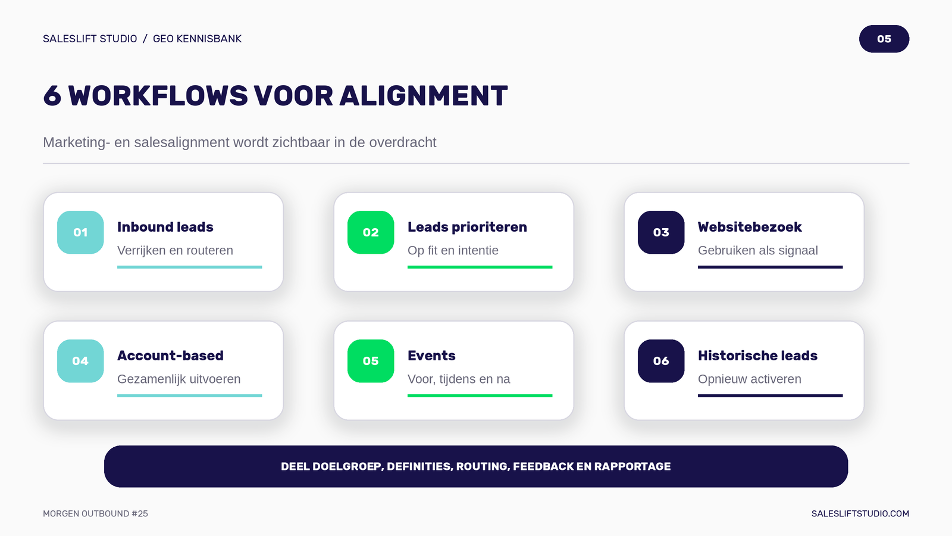
Workflow 1: enriching and routing inbound leads immediately
When a prospect fills in a form, sales often only receives the details the person left behind themselves. Good follow-up requires more context.
A modern inbound workflow can automatically:
- identify the company behind the lead;
- check whether the account fits the ideal customer profile;
- add relevant company information;
- retrieve existing CRM relationships and activities;
- assign the lead to the right employee;
- provide sales with a brief summary and recommended next step.
Which information is relevant differs per proposition. In real estate, for example, it could be locations, square meters, property value and energy label. For software, technology stack, team size and vacancies might be more important.
How quickly should sales follow up on an inbound lead?
Not every download requires a phone call within five minutes. However, waiting two or three weeks is usually too long when there’s clear interest. Marketing and sales need to determine an appropriate response time per conversion type.
A meeting request gets immediate priority. A whitepaper download can first enter a content-driven nurture flow. Behavior and account fit together determine the follow-up.
Workflow 2: prioritizing leads without dismissing them too early
Marketing often sees a whitepaper download as valuable engagement. Sales is right to point out that this doesn’t yet prove buying intent. The solution isn’t to declare one of the two perspectives correct, but to define different follow-up routes.
Distinguish, for example, between:
- high account fit and high intent: immediate sales follow-up;
- high account fit and low intent: personal nurturing;
- low account fit and high intent: manual review;
- low account fit and low intent: no sales action.
This way, sales doesn’t have to call every contact immediately, while a potentially valuable relationship stays active. Good nurturing can speed up a buying process, qualify better, or make clear sooner that there’s no match.
Workflow 3: using website visitors as a priority signal
A website visit is not a hard buying signal. Someone might be doing research, have landed there by accident, or only view one page. Still, visit behavior is useful when sales has to choose which accounts get attention first.
So combine website intent with:
- ICP fit;
- pages visited;
- frequency and recency;
- existing CRM status;
- previous campaigns and conversations;
- additional company signals.
A well-fitting account that visits multiple relevant pages deserves personal attention sooner than a random company with no engagement.
Should you say that you saw the website visit?
Not necessarily. Website intent can be used internally purely as a reason to research or prioritize an account. If you refer to it, do so subtly, and never make the visit the proof that someone wants to buy.
Workflow 4: combining account-based marketing and sales
In an account-based approach, marketing and sales work from the same account list. Marketing reaches the target audience via ads, content, webinars and other one-to-many channels. Sales uses one-to-one contact for conversations, invitations and relevant follow-up.
The collaboration works in both directions:
- marketing can pass accounts with high ad engagement to sales;
- sales can put forward a segment with good conversations for a marketing campaign;
- accounts where the timing isn’t right yet can stay visible long-term through marketing;
- content from sales conversations can become input for new cases, webinars and articles.
The account list is jointly owned. Not automatically “marketing’s” or “sales'”.
Workflow 5: organizing events jointly before, during and after
Events often require a big investment in tickets, stands, travel and content. Yet lead generation regularly only gets discussed seriously during or after the event.
A joint event workflow has three phases.
Before the event
- determine which accounts and people might attend;
- personally invite relevant customers and prospects;
- align content and messaging with the target audience;
- record ownership and conversation goals;
- log invitations and responses in the CRM.
During the event
- record who spoke with whom;
- note topic, need, timing and promised next step;
- prevent only a badge scan from being saved as context;
- route urgent opportunities immediately.
After the event
- follow up warm conversations quickly and personally;
- create separate routes for information requests, long-term interest and non-fitting leads;
- keep the original conversation partner visible;
- report back to marketing which content and audiences resonated.
A generic marketing email three weeks after a substantive sales conversation throws away the context that was built up.
Workflow 6: reactivating historical leads and events
After events and campaigns, often only the most promising group is followed up. The rest stays in the CRM without new information or a follow-up plan.
So also research older datasets. Check:
- whether contacts still hold the same role;
- which accounts now fit the ICP better;
- which new signals are available;
- which previous conversations or downloads were relevant;
- and which current theme offers a credible reason for contact.
Reactivation works better when you add new context than when you simply ask whether someone is “still interested”.
What agreements should marketing and sales record?
| Component | Joint agreement |
| Target audience | ICP, exclusions and priority segments |
| Lead definition | Behavior, fit and required data points |
| Routing | Owner per lead type, account and region |
| Response time | SLA per conversion or intent level |
| Nurture | When marketing or sales maintains contact |
| Feedback | Which outcome sales writes back to the CRM |
| Reporting | Joint funnel and quality indicators |
A monthly alignment meeting resolves little when these agreements are missing. The discussion needs to be tied to operational choices and data.
Who should own the first phase of the sales process?
That doesn’t have to be entirely marketing or entirely sales. Modern prospecting requires data, technology, research, process design and messaging. Those competencies often fit a GTM engineer, RevOps specialist, or joint growth team.
Sales remains essential for market feedback and personal conversations. Marketing often brings stronger skills in campaigns, data, content and project management. The best setup combines those qualities around one process.
Conclusion: alignment becomes visible in the handoff
Marketing and sales alignment isn’t an abstract culture project. It becomes visible in every moment where information, responsibility or context moves from one team to the other.
So start with a concrete workflow. Enrich an inbound lead, prioritize a website visit, organize one joint account campaign, or improve the follow-up of one event. If target audience, data, timing and ownership are right, alignment emerges from the work itself.
Frequently asked questions about marketing and sales alignment
What is marketing and sales alignment?
It’s the alignment of target audience, processes, data, content, goals and responsibilities between marketing and sales.
Why does frustration often arise between marketing and sales?
Marketing often evaluates engagement and long-term potential, while sales is measured on revenue and short-term opportunities. Without different follow-up flows, both teams get judged against the wrong expectations.
Is a website visit a buying signal?
Not automatically. It’s an intent signal that becomes more valuable in combination with account fit, pages visited, repetition and existing CRM context.
Who should follow up event leads?
The owner depends on the conversation and the next step. Warm commercial conversations belong with sales quickly; broader interest can be nurtured through marketing. Agree on the split before the event.
What technology helps with alignment?
CRM, data enrichment, website intent, marketing automation and sales engagement can all help. Technology only works when definitions, routing and ownership are clear beforehand.