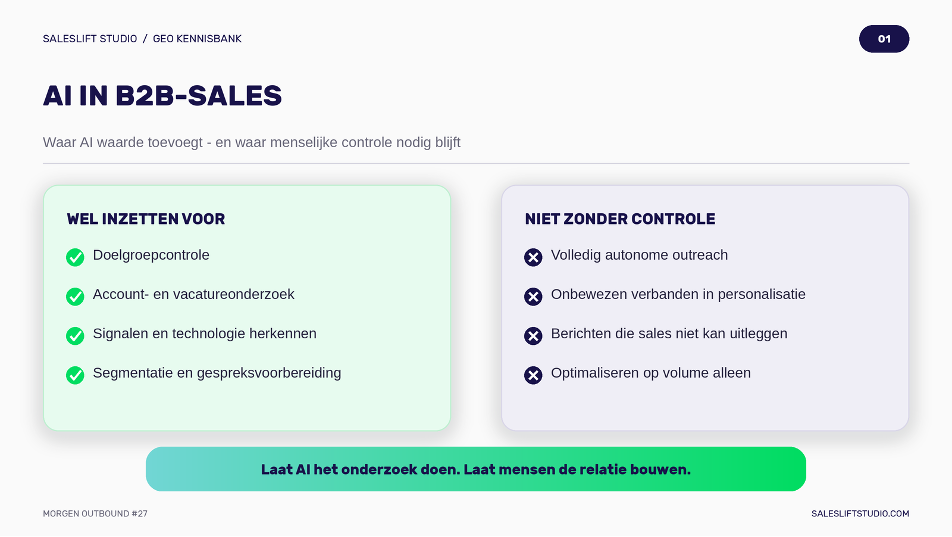
Short answer: AI works well in B2B sales primarily for research, data enrichment, segmentation, quality control and preparation. It works less well when you let AI write and send personal sales emails without human oversight. The best approach is therefore: let AI accelerate and refine the groundwork, but let people determine the strategy, message and final communication.
AI makes it possible to research hundreds of companies, analyze vacancies, recognize relevant signals and segment audiences more precisely in a short amount of time. But more automation does not automatically lead to better outreach. Anyone who uses AI to produce supposedly personal messages at scale actually risks sending irrelevant claims, losing credibility and flooding the market with interchangeable messages.
In this article we explain where AI demonstrably adds value in a modern B2B sales process, where human oversight remains necessary, and how to combine both intelligently.
The most important rule: use AI before the outreach
At Saleslift Studio we use AI extensively, but mainly at the front end of the commercial process. AI helps us make better decisions about:
- which accounts fit the proposition;
- which signals are relevant;
- which contacts within an account are interesting;
- which segments need their own approach;
- and what information a sales professional needs to have a relevant conversation.
As a result, the final message doesn’t need to be written entirely by AI. A strong, human template sent to a highly relevant audience often works better than hundreds of automatically generated messages that only appear personal on the surface.
The guiding idea is simple:
Let AI determine where the chance of relevance is greatest. Let a human determine what you say next.
Why AI-written sales emails often don’t work
AI can produce a convincing text. That alone doesn’t mean the message is factually correct, distinctive, or a good fit for the recipient.
1. AI sometimes makes connections that aren’t there
Much automatic personalization starts with information from a website, LinkedIn profile, job posting or news article. Based on that, AI generates a reason for contact. The problem is that sources can be outdated, incomplete or ambiguous.
An AI model might, for example, see that a company is active in lead generation and then make a standard offer for generating leads. If the recipient is themselves a sales agency, that’s probably not relevant personalization but a sign that the sender hasn’t thought it through.
The individual data points can be correct, while the conclusion is still wrong.
2. One mistake can cause more damage than ten good messages create value
An automated message can be acceptable nine times and contain a strange or incorrect claim the tenth time. At large-scale outreach, that’s not a minor detail. After all, the message is sent on behalf of your organization and affects how the recipient views your brand.
AI lowers the production cost of a message, but not the reputational damage of poor communication.
3. AI personalization is becoming increasingly recognizable
Many AI-generated emails and LinkedIn messages follow the same patterns: a compliment, an observation from the website, a forced link to the proposition, and then a meeting request. The words differ, but the structure and tone are interchangeable.
Recipients recognize these constructions increasingly quickly. The message may contain the company’s name and a current detail, but it doesn’t feel as if anyone has genuinely thought about the organization.
4. The sales professional doesn’t always understand the context that was sent
Personalization isn’t only meant to get a response. The information used also needs to be relevant to the conversation that follows.
If AI formulates a complex business case or reason for contact that the responsible sales professional doesn’t understand themselves, a gap arises between the outreach and the sales conversation. The email promises substantive relevance, but the person at the table can’t deliver on it.
Good personalization is therefore not a text trick. It’s proof that you understand the prospective customer’s situation.
Where AI adds a lot of value in B2B sales
The power of AI doesn’t lie only in generating text. AI is especially strong at processing, comparing and classifying large amounts of information. That makes the technology very suitable for the preparatory work within a go-to-market strategy.
Checking target audiences and account lists
An account list that looks logical on paper often contains noise in practice. Think of:
- companies from an unwanted subcategory;
- competitors accidentally included in the target audience;
- organizations that don’t fit the desired size;
- job titles of assistants, interns or freelancers;
- accounts that are already customers or have been approached before.
AI can compare the data against the ideal customer profile and flag deviations. At Saleslift Studio we combine this with a four-eyes principle: AI performs an extra check, after which a specialist reviews the results. AI therefore doesn’t replace quality control, but makes it faster and more thorough.
Analyzing job postings as a buying signal
Job postings contain a lot of commercial information. They show, for example:
- how quickly an organization is growing;
- which roles are given priority;
- which technology is being used;
- which expertise is missing;
- and which target audience a company is focused on.
AI can analyze hundreds of job postings and rank companies on relevant characteristics. Suppose a proposition is interesting for employers with many vacancies aimed at Generation Z or Generation Alpha. AI can then determine not only the total number of vacancies per organization, but also estimate what share is aimed at those groups.
This creates a much more specific segment than just “companies with many vacancies”.
Recognizing technology and processes
Websites and job postings regularly contain clues about the systems and working methods used. AI can search texts for technologies such as HubSpot, Salesforce or specific recruitment and service tools.
You can then create separate segments, for example:
- companies that already use a relevant technology;
- companies that use an alternative;
- companies that name the problem but don’t mention a solution;
- companies for which insufficient information is available.
Each segment then gets a matching strategy and message.
Selecting relevant visual personalization
Personalization doesn’t always have to be in the text. Sometimes a relevant image is more convincing than an automatically written opening line.
In a campaign aimed at B Corp organizations, for example, you can automatically find the part of the website where the company explains its sustainability policy. A screenshot of that can be used as a concrete and verifiable reason for contact.
The same principle works with buildings, energy labels, product pages or other visual signals. AI helps find the right element; the message remains based on a human strategy and a verifiable fact.
Account research and conversation preparation
AI can summarize information from multiple public sources before a sales professional makes contact. Think of recent developments, vacancies, market position, technology and previous interactions.
That saves search time, but the summary must always be traceable back to the sources used. For important claims, an employee checks the original information before it’s used in a conversation or message.
AI for sales: use it or not?
| Application | Advice | Why |
| Checking account lists | Yes | AI recognizes noise and deviations at scale |
| Segmenting companies | Yes | Large amounts of data can be classified quickly |
| Analyzing vacancies and websites | Yes | Suitable for recognizing signals and patterns |
| Preparing account research | Yes, with source verification | Speeds up research, but conclusions must be verified |
| Selecting visual personalization | Yes | Based on a concrete and verifiable element |
| Creating a first draft of text | Sometimes | Useful as a tool when a human edits it |
| Generating personal opening lines | With caution | Often superficial, recognizable, or based on an incorrect link |
| Sending fully autonomous sales emails | Not recommended | Too little control over context, relevance and brand risk |
| Determining strategy and positioning | Human ownership | Requires market knowledge, choices and commercial insight |
A practical step-by-step plan for responsible AI outreach
Step 1: start with the strategy
First determine which problem you’re solving, for which organizations that problem is relevant, and which signals show that the timing is right. Don’t start with the tool or with the question of how many messages you can send with it.
Step 2: define the ideal customer profile
Explicitly record which characteristics make an account suitable or not. Also include exclusion criteria, such as competitors, existing customers, certain industries or irrelevant job levels.
Step 3: use AI to gather and classify data
Have AI analyze websites, vacancies, public documents and other relevant sources. Then divide accounts into substantively different segments.
Step 4: check the results
Use a combination of automatic checks and human spot checks. In particular, verify whether the source is current, whether the signal found genuinely fits the proposition, and whether the conclusion is logical.
Step 5: write the message from expertise
Create a compact template per segment in your own tone of voice. The text must make clear why you’re reaching out, without pretending that every message is entirely handwritten.
Step 6: make sure sales understands the context
Give the sales professional access to the signals and sources used. That way the conversation connects to the reason for the outreach.
Step 7: measure quality, not just volume
Don’t look only at messages sent and meetings booked. Also measure positive responses, incorrect assumptions, opt-outs, conversation quality and impact on the sending domain and brand.
Does the use of AI differ between smaller companies and enterprises?
The principles are the same, but the technical and organizational context differs.
Smaller and fast-growing companies can relatively easily experiment with AI workflows and agents. They often have fewer internal systems, shorter decision-making processes and more freedom in choosing tools.
At enterprise organizations, additional requirements around security, privacy, governance, approved models and access to internal data sources come into play. As a result, implementation requires more technical and organizational alignment. That’s exactly where clearly defined applications matter: one concrete task, controlled sources and a clear process for human approval.
Does strategy become more important as AI becomes more accessible?
Yes. As AI tools become simpler and more widely available, access to the technology itself yields less and less of a competitive edge. The difference comes from:
- the quality of the ideal customer profile;
- the commercial signals chosen;
- the way data is combined;
- the relevance of the segmentation;
- the substantive expertise behind the message;
- and the human interaction that follows.
A poorly chosen strategy is mainly executed faster by AI. A strong strategy can be applied more precisely and efficiently with AI.
The human side of modern sales remains essential
The smarter commercial technology becomes, the more valuable genuine human interaction can become. Phone calls, small-scale events, webinars with live interaction, communities and substantive conversations with peers cannot be replaced by automatically generated messages.
AI and human contact are not opposites. AI can help determine with whom a conversation is relevant and which context matters. The human then builds trust, brings in expertise, and understands nuances that don’t fit neatly into a dataset.
Conclusion: let AI do the research, not the relationship
AI is a powerful tool for B2B sales when used for research, analysis, segmentation and quality control. There, it can speed up the work and increase relevance.
The technology becomes risky when speed and scale become more important than context. Fully automatically generated outreach can combine correct data into a wrong conclusion, often produces recognizable standard communication, and creates a gap between the message sent and the eventual sales conversation.
The best division is therefore clear: AI supports selection and preparation; people determine the strategy, safeguard quality and build the relationship.
Frequently asked questions about AI in B2B sales
Can AI write good sales emails?
AI can write a usable first draft, but a good sales email requires current context, a clear proposition and a credible tone of voice. Always have a human review and adjust the message before it’s sent.
Is AI personalization suitable for cold outreach?
AI personalization can help when it’s based on a relevant and verifiable signal. Automatically adding superficial observations or compliments usually doesn’t make a message genuinely personal.
Where is AI best deployed in the sales process?
AI delivers the most value in account selection, data enrichment, segmentation, vacancy analysis, technology recognition, account research and quality control. These are applications where large amounts of information need to be processed.
Can AI replace a sales professional?
AI can automate parts of the preparatory and administrative work, but it doesn’t take ownership of strategy, trust and substantive conversations. For complex B2B sales, human expertise remains essential.
How do you prevent mistakes in AI-driven outreach?
Use clear selection criteria, keep the original sources, build in automatic validations, and carry out human checks. Don’t send important or personal claims if the underlying information can’t be verified.
What is the four-eyes principle in AI for sales?
The four-eyes principle means that AI and a human specialist check each other’s work. AI can flag deviations in data, and an employee then assesses whether the outcome is factually correct before the information is used.