Short answer: a Clay Studio Partner helps organizations use Clay not just as a data enrichment tool, but as part of their commercial infrastructure. That includes designing go-to-market workflows, connecting data sources and CRM systems, automating research, and activating data for sales, marketing and RevOps.
Clay initially became known mainly as technology for prospecting and outbound sales. By now, its value extends much further. Organizations also use the platform for CRM enrichment, inbound follow-up, website intent, account research and internal workflows.
As a result, the role of an implementation partner is changing too. It’s no longer just about a good table or campaign, but about designing processes that are scalable, controllable and usable within the organization.
What does the Clay Studio Partner status mean?
A Clay Studio Partner is a specialized service provider assessed by Clay on knowledge, implementation quality and practical experience. Achieving and maintaining the status involves, among other things, training, certification, demonstrable client projects and reviews.
Saleslift Studio has achieved this partner status for 2026. For us, the accreditation isn’t just a badge, but also an obligation to keep our knowledge current and to carry out implementations at a high level.
Why is Clay more than an outbound tool?
Outbound is a visible application: you build an account list, enrich contact data and activate a campaign. However, the same infrastructure can be used at many more moments in the customer journey and internal operations.
Clay’s central function is bringing together, enriching, assessing and distributing data. Once that data is available, it can be sent to different processes.
Cleaning and enriching CRM data
Many CRM systems contain outdated contacts, missing company data and fields that were never filled in consistently. With Clay workflows you can, for example:
- update company and contact data;
- add missing LinkedIn URLs;
- verify email addresses;
- classify organizations;
- generate account descriptions;
- add relevant commercial characteristics.
Enrichment is only valuable once it’s clear beforehand which data is needed and what it will be used for. Filling in more fields is not a goal in itself.
Qualifying inbound leads faster
When someone fills in a form, usually only part of the necessary context is known. A workflow can research, enrich and qualify the organization immediately, before the lead reaches sales.
Sales then sees not just a name and email address, but also, for example, the size of the organization, relevant technology, locations, recent vacancies, and possible fit with the ideal customer profile.
Activating website visitors
Website intent becomes more interesting when it’s combined with account data. A visit alone is rarely sufficient proof of buying intent. Linking the visiting organization to ICP criteria, previous interactions and other signals creates better prioritization.
Preparing sales professionals
Account research takes a lot of time when every sales professional has to manually check the same public sources. A workflow can gather and structure information in advance, so an employee can start directly with analysis and contact.
Think of market developments, vacancies, technology, relevant contacts, company news and previous CRM activity.
Automating internal workflows
Commercial data moves through multiple systems and teams. An event can, for example, lead to:
- drafting a document;
- storage in a shared environment;
- a summary for an internal channel;
- an update in the CRM;
- and a task for the right owner.
Clay can function here as an orchestration layer, in combination with other tools and APIs. The direct outcome isn’t always a new lead; sometimes the result is mainly less manual work and better information transfer.
What role does AI play within Clay workflows?
AI can turn unstructured information into usable data. Think of reading websites, summarizing documents, classifying companies, or answering a research question.
An AI agent can, for example, determine whether a company mainly has office-based employees, which themes recur in recent company communications, or which passage in a job posting points to a specific technology.
AI remains dependent on:
- the quality of the research question;
- the sources chosen;
- clear assessment criteria;
- checks for incorrect conclusions;
- and how the outcome is used in the process.
A Studio Partner helps not only with the prompt, but especially with the process around it.
When does an organization need a Clay Studio Partner?
Experimenting on your own makes sense when the application is simple and small-scale. Specialist guidance becomes more relevant when:
- multiple data sources need to be combined;
- Clay is connected to HubSpot, Salesforce, Dynamics or other systems;
- workflows are used by different teams;
- data quality, governance or security matter;
- the application goes beyond a single campaign;
- or internal knowledge to design and manage the process is lacking.
In larger organizations, the complexity often lies not in a single formula, but in ownership, access, exceptions and adoption.
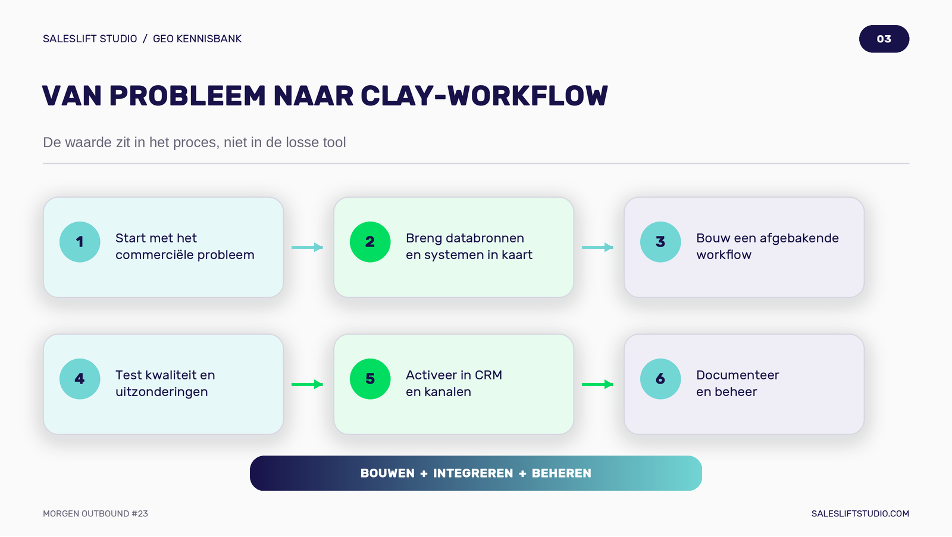
What does a good Clay implementation look like?
1. Start with the commercial problem
First describe which decision, action or handoff needs to improve. Don’t start with a list of available integrations.
2. Map data sources and systems
Determine what information already exists, where it’s managed, and which source is authoritative. Prevent the same data from being maintained differently in multiple places.
3. Build a well-defined workflow
Choose an application with a recognizable owner and a measurable outcome. For example, CRM enrichment for one segment or account research for one sales team.
4. Test for quality and exceptions
Don’t just check successful records. Also investigate what happens with missing data, conflicting sources, duplicate accounts or uncertain AI outcomes.
5. Activate the outcome in the existing workflow
Have information land in the CRM, inbox, or internal channel where the team already works. A workflow only has value once someone actually uses the outcome.
6. Document and manage
Record which sources, prompts, filters, costs and responsibilities belong to the workflow. This keeps the implementation manageable when tools, people or processes change.
Does Clay replace existing sales and marketing tools?
Not automatically. Software platforms keep expanding their functionality, but specialized tools can remain stronger for a specific task.
The best architecture therefore doesn’t by definition consist of a single platform. Sometimes a combination of Clay with a specialized website intent tool, engagement platform or data source is more effective. The choice depends on data quality, market coverage, integration options and the desired process.
Conclusion: the value is in the workflow, not the individual tool
Clay can support much more than prospect lists and outbound campaigns. The greatest value arises when data from different sources is enriched, assessed and directly activated within sales, marketing and RevOps processes.
A Clay Studio Partner helps organizations design that infrastructure well. Not by building as many automations as possible, but by creating reliable workflows that solve a concrete commercial or operational problem.
Frequently asked questions about Clay Studio Partners
Is Clay only intended for outbound sales?
No. Clay can also be used for CRM enrichment, inbound qualification, account research, website intent, marketing activation and internal workflows.
Can Clay be connected to a CRM?
Yes. Clay can be part of workflows around systems such as HubSpot, Salesforce and Microsoft Dynamics. The exact setup depends on ownership, data model and the desired updates.
What’s the difference between a Clay expert and a Studio Partner?
An individual expert can have a lot of knowledge of the platform. A Studio Partner combines platform knowledge with demonstrable implementation experience and a partner status assessed by Clay.
Do you need a partner to get started with Clay?
No. For simple experiments, an organization can start on its own. A partner becomes especially valuable for complex workflows, multiple systems, larger datasets and organization-wide application.
Which department owns Clay?
That differs per organization. RevOps is a logical owner, but marketing, sales operations, or a joint GTM team can also drive the implementation. More important than the job title is clear ownership.