THE BACKGROUND
Eneco OpwekOptimaal is a proposition that lets solar panel owners smartly control their solar panels — for example, during negative market prices — and it helps address the challenge of grid congestion.
For this proposition, we wanted to specifically approach companies that already have solar panels on their roof. The goal was to open the conversation in a relevant way, in order to have a sales conversation about this new Eneco proposition. The challenge wasn’t the offer itself, but mainly getting attention. So we looked for a way to combine high relevance and attention value with scalability and effective execution.
THE IDEA
We decided to only approach companies where we could determine in advance, with high probability, that they had solar panels. We also wanted to demonstrate this directly in the email itself, so the message wouldn’t feel like cold outreach, but like a well-founded observation.
This meant we:
- Built a targeted list based on industry, surface area, and available data on the presence of solar panels
- Identified the right decision-makers within these organizations
- Added visual proof in the form of a screenshot of the roof
The combination of data, visual proof, and personalization was meant to drive higher relevance and attention value.
THE PROCESS
We started by compiling a list of companies most likely to have solar panels. Using Company Info, this list was fully enriched through a workflow in Clay with company and contact details for the right person within the organization, including address details and Google Maps links.
A screenshot of the satellite image was automatically generated from these Google Maps links. This image was added to our outreach tooling, which was used to send emails at scale on behalf of Eneco’s account managers.
To make sure the companies actually had solar panels, the satellite images were manually checked at the last moment. Organizations that didn’t qualify were excluded or moved directly to a different campaign.
The combination of automated enrichment and visual personalization resulted in a campaign that was both personal and largely automated operationally.
THE RESULT
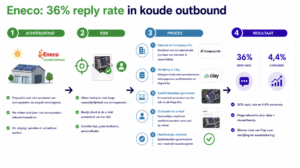
The campaign achieved a reply rate of no less than 36 percent, and a conversion rate of 4.4 percent. So this works!
This approach shows that relevant outreach doesn’t necessarily have to be manual. By smartly using Clay for data enrichment and automation, combined with “visual proof,” personalization at scale can be executed with demonstrable results.